Tuesday, April 25, 2023

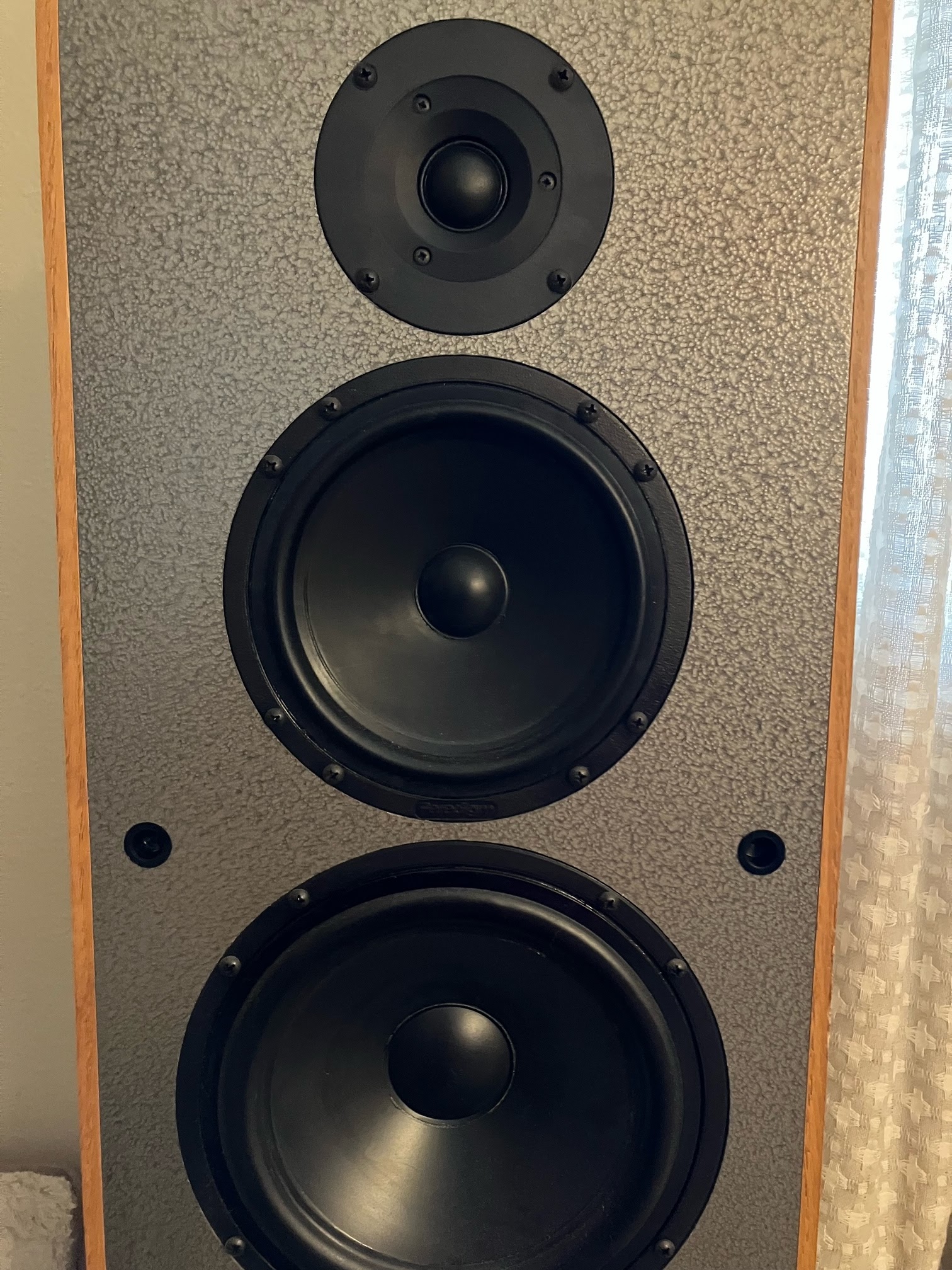
Paradigm Studio Monitors - Tweeter Replacement

After years of admirable service (manufactured early 90s, bought ~2010), the left tweeter did not produce sound anymore. Thankfully, the rest of the drivers were fine. Crossover seemed ok also - tested via swapping the tweeter with the right speaker.

These usually played audio from a Logitech Squeezebox (a surprisingly vibrant open-source community now) or Pioneer Elite DV-59AVi, both to a Sony STR-DA7100ES (i-link firewire with H.A.T.S, PQLS). No bi- or tri-amping.

Access to the tweeter is through the front, behind the dust screen. The rear does not seem user serviceable.

A multimeter test showed intermittent open circuit or ~ 100s of Ohms. Nominally 6 Ohms.

Original markings were: D26TG-56, 6 Ohms, 902 . Some digging revealed these as Vifa 1-inch silk dome tweeters.

I was going to call Paradigm. At this time, e-mail is the only option. Their response took about a week. They have these tweeters. They were $175 a piece, plus shipping; crossovers were $125 plus shipping.

I elected to use these: Peerless D27TG35-06 . Seemed to be a good fit visually. There were a few options for replacement silk/fabric dome diaphrams, but their value was not compelling.


In the pictures below, the left is the original; the right is the replacement. Though they looked very close, there was a slight out of round difference between the original and new frame. I swapped the frames, and installation went ok.  Though the mounting screws had different heads, the length and the type of screws were compatible.
The height difference did not seem to make a difference in this application.


The innards look similar also. 


People usually scoff at break-in for electronics. But in this case, it made a difference in my setup, to my ears. After installation, the new tweeter sounded like it had low gain, compared to the stock one. After a couple of days, it recovered gain and sounded much better - almost on par with the original. I still think the original sounds a tad better, but I am happy with the value proposition. 


References:

  1. Stereophile review 1992. Lists a metal dome tweeter. My example had a silk dome tweeter.
  2. Not very helpful literature from Paradigm


Thursday, January 7, 2021

Burson V5i in Sony DVP-S7000

As readers of this blog may know, my reference CD player is a DIY modified Rotel RCD-855. 

I also have a Sony DVP-S7000 and it is revered for its transport. People also consider upgrading output opamps a big step up. 

Burson kindly sent me V5i Dual op-amp samples and its compact size seemed like a good fit in this application.

I measured the input voltages for IC202 and IC302. They were non-symmetric. About -7V and 5V , comfortably within the V5i spec of +/-15V . I did not change  LPFs IC201 and IC301. I had to tweak the legs a little to make the V5i stay and have good contact, since the board would be mounted upside down. Perhaps the trouble was with the opamp sockets.

I also swapped out the 100uf, 25V coupling capacitors with Blackgates from a donor. 

From previous comparisons, this Sony was different and quite far away from my Rotel reference. I spun up some CDs and compared them now. I realize this is not ideal: only changing one component, keeping everything else the same. But it was what was possible in this case.

At first, bass sounded boomy on the Sony. Per Burson's recommendation, I let it run for ~ 100 hours. It sounded better after that. 

During the comparison:

  (1) Bass sounded impressive on the Sony. Details were different with the Rotel. 

  (2) L and R channels seemed more coherent on the Sony. Choruses and ambience were better on the Rotel. High frequencies were exquisite on both.

  (3) Instruments individually sounded better on the Sony. Vocals were a tad recessed on the Sony. The whole sounded slightly better on the Rotel

The reference Rotel still stays ahead by a hair. But the Sony has improved by leaps and bounds.

Songs:

(1) Fragile
(2) Why Should I Cry For You
Fields of Gold: The Best of Sting 1984-1994
Sting

(3) Fill Her Up
Brand New Day
Sting

(4) The Hat
(5) The Way I Am
Girls and Boys
Ingrid Michaelson

Associated equipment:

Iron SE DIY preamp  Zen Mod Labs

Babelfish ᄅſ DIY power amplifier  Zen Mod Labs

Pioneer SP-FS51-LR speakers


References: 

http://www.agoraquest.com/forums/viewtopic.php?t=32249


Build quality is excellent. I am surprised by the number of ICs


Original OpAmps

 
Caps swapped and sockets installed

 
V5i-D installed


Tuesday, December 29, 2020

Klipsch Promedia 2.1: fixing a broken channel

After years of living with only a single channel, I attempted a repair and it has been successful so far. Though there is a turn on thump (perhaps because the output devices are not as matched), it seems to work ok. 

In one HF channel, the fuse had blown and kept blowing. This was the initial symptom. I suspect the culprit was the original goop used to hold things together. It became conducting and shorted out one output device (TIP41C). The blackening of the board is suggestive of this.


Thanks to the excellent work by the folk listed in the references below, I had an idea of what to do. In the end, I replaced both Q9, Q10 (TIP41C and TIP42C respectively), and Q6 2N3904. TIP41C had all terminals shorted; TIP42C measured ok. I also changed out a couple of resistors that seemed very charred, though they measured ok (They fell apart when removed from the board). There were mica insulators between the output devices and the heatsink. I cleaned the old heatsink compound and applied new compound. The main clue was to compare measurements between the working and non-working channels.


There is an initial offset of about 60mV in the channel I repaired. This is about 20mV in the other channel. They both settle to about 5mV higher in a few minutes. There was some discoloration in the LF amp board but I did not change anything since it works.

References:

http://christopherbradshaw.net/The_Project_Bin/klipsch%20promedia%20subwoofer%20repair%20-%20page%201.html

http://www.thompdale.com/bash_amplifier/2-1/2-1_bash_amp.htm

http://diyaudioprojects.com/Forum/viewtopic.php?t=4892

Sunday, November 1, 2020

Review of Burson Audio Classic V6 op amp in a DIY WHAMMY headphone amplfier

 Thanks to Burson for providing V6 Classic Duals.

Summary? I like V6 Classic over V6 Vivid, in this application.

I changed my testing slightly from my earlier review of V6 Vivid. A couple of different songs. Source volume from the phone is full.

These stayed the same:
Input: Samsung Galaxy S9 plus
Headphones: Sony MDR-7506
No changes to WHAMMY (18V transformer, naked 15V regulators)

The goal is to pick between V6 Classic and the earlier samples of V6 Vivid. Again, I listened to both the op-amps back to back. No instrumentation.

Songs:
(1) Track 1 Unaccompanied Cello Suite No. 1 in G Major, BWV 1007: I. Prélude from Six Evolutions - Bach: Cello Suites, Yo-Yo Ma (2018)
(2) Track 4 The Four Seasons, Violin Concerto in F Minor, Op. 8 No. 4, RV 297 "Winter": II. Largo from Appassionato, Yo-Yo Ma (2007)
(3) and (4) Fragile and Be Still My Beating Heart, Tracks 9 and 6 from Fields of Gold: The Best of Sting 1984–1994 (1993-1994)
(5) Sugar, Track 6 from Free Life, Dan Wilson (2007)
(6) Lies, Track 6 from After Forever, Kasper Bjørke (2014)
(7) You're Getting to Be a Habit with Me, Track 8 from Love Scenes, Diana Krall (1997)
(8) and (9) Breakable and The Way I Am, Tracks 3 and 5 from Girls and Boys, Ingrid Michaelson (2006)

Vivid:
Fragile: Somewhat fatiguing
Be Still My Beating Heart: The supporting chorus was clear
Sugar: Midrange was better than high frequencies (which sounded a little recessed)
Good supporting vocals

Classic:
Fragile: Chorus sounded good
Be Still My Beating Heart: The Guitar sounded nicer than the chorus. Delicate high hats
Sugar: Even better Midrange instruments. Voices had more emotion.
Lies: More complex presentation of instruments
Breakable: The hand drum in the left channel was fantastic. Beautiful lower bass.

Vivid made instrument separation good. Classic let me distinguish between the different notes made by those instruments.
With the Classic, I started to enjoy the music.

I'll keep the Classic in my Whammy. 


Wednesday, September 16, 2020

Review of Burson Audio Vivid V6 op amp in a DIY WHAMMY headphone amplfier


Thanks to Burson Audio for the samples of Supreme Sound OpAmp Vivid V6.
Marking on the box: V6V-D-2
It came thoughtfully packaged with 2 DIP-8 adapters. I had already installed such an adaptor in my Whammy.

My build was with the PCBA from https://diyaudiostore.com/. I sourced parts myself and stumbled many times with lots of rework.

Supply: +/- 15 V straight regulators. no LED or voltage divider
Input:  Samsung Galaxy S9 plus. Volume two notches below maximum
Headphones: Sony MDR-7506

Gain with the Vivid V6 seems to be higher than with the baseline OPA2134PA. Gain matching was by ear. I realize this is not as accurate as with instrumentation. This was not a blind test. I heard the songs below with the OPA2134PA and then swapped it out for the Vivid V6, leaving everything else the same.

I had to move surrounding components a little. The footprint of the Vivid V6 is a little larger. Luckily, the box I used is big enough for height. so I'll let it stay a while.

(1) Track 1 Unaccompanied Cello Suite No. 1 in G Major, BWV 1007: I. Prélude
from Six Evolutions - Bach: Cello Suites, Yo-Yo Ma (2018)
(2) Track 4 The Four Seasons, Violin Concerto in F Minor, Op. 8 No. 4, RV 297 "Winter": II. Largo from Appassionato, Yo-Yo Ma (2007)
(3) and (4) The Hat and The Way I Am, Tracks 4 and 5 from Girls and Boys, Ingrid Michaelson (2006)
(5) Track 2 Künstliche Welten (Praha-Edit) from Künstliche Welten, Wolfsheim (2004)
(6) Track 10 How Deep Is the Ocean (How High Is the Sky) from Love Scenes, Diana Krall (1997)

The sound: there is more detail and more bass. Notes, and instruments are separately identifiable.

After this I continued to listen to many songs with the Vivid V6. In familiar songs, I was surprised, especially at the start and end of songs: sometimes I could discern extra vocals, instruments or notes.

That said, I think I am spoiled by ZenMod's Iron Pre. With that, I enjoy the music without paying attention to accuracy or anything else. With the Vivid V6, with my setup, to my ears, there seems to be something amiss. I don't know how else to say it.

In the words of our resident wise man "this is Entertainment - not Dialysis". It is good to have choices and even better to listen to a few.

Links:
https://www.bursonaudio.com/products/supreme-sound-opamp-v6/
https://www.ti.com/store/ti/en/p/product/?p=OPA2134PA
https://pro.sony/ue_US/products/headphones/mdr-7506
https://guides.diyaudio.com/Guide/WHAMMY+headphone+amplifier/3

"this is Entertainment - not Dialysis" from http://www.firstwatt.com/pdf/art_h2_v1.pdf


Monday, November 10, 2014

DVDA

I tried a few methods, but none made a functioning DVDA (in Pioneer Elite DVD-59AVi) until this
http://rdhsoftware.blogspot.com/p/dvda-gui.html

It is a front end for a few other open source software.

It seems to have trouble with files of different sample rates. But not those sample rates itself. For example, mixing an 88Khz and a 96Khz file - no go. But each works separately.


Wednesday, October 29, 2014

Reset Pioneer DVD players without a display or remote

1) Switch the player into standby and empty the disc tray.
2) Using the front panel buttons, hold down the STOP button and press STANDBY/ON to switch the player back on.

From

http://www.pioneerfaq.info/english/dv400.php?player=DV-400V&question=Extras

Saturday, October 18, 2014

Squeezebox Duet Duel

Due to a missing power supply and not reading the amps rating of power supplies, I happen to have two Squeezebox Duets.

So I used most of http://lampizator.eu/lampizator/Squeezebox/squeezebox.html on one and they had a duel.

Before this, I also compared the RCA SPDIF output of the modified player and a Squeezebox touch, piping the signal to a Sony DA7100ES, headphone output. I couldn't tell the difference.

On to compare the analog outputs of both Duets. They fed the analog inputs of a Grace Designs Model 901 headphone amp. I used my Focal spirit one pro.

The test was a single blind, I did not know which was which. But I did know that they were different and I was switching between them. I wrote down my thoughts and the modified one won.

My first thought was that the unmodified one sounded like most other DACs. The modified one had more natural sounding instruments and had nicer layering of vocals. Drums sounded nicer too.

Next up, comparing digital outputs to each other.

2014/10/29
There is a difference between the modded player and the unmodded player. Both were feeding a the digital input of Grace Designs Model 901 headphone amp. I used my Focal spirit one pro.

I only used two songs. Faith and Hand to Mouth by George Michael. The unmodded player sounded fuller, boomy. The modded player revealed more details and instruments sounded more natural. Overall, more pleasant.

These were different. Some may prefer the sound of the unmodded player.

To throw a kink in the works, I also used a Pioneer DV38A. To me, that was the winner. Somewhere in the middle full sounding. And exquisite highs. All those transformers and parts help.

Tuesday, May 13, 2014

Another list

By popular demand :)

Headphones:
Grado SR60
Sennheiser HD280 Pro
Panasonic RP-HTF600-S
Monoprice 8323
Focal Spirit Professional
Stax SR Lambda Pro
 
Earphones:
Sennheiser MX500
Panasonic ?
Monoprice 8320 IEM

Headphone amps:
Electric Avenues PA2V2
Grace m901
Stax - SRM-1/MK2
Schiit Vali

Portable audio players:
First generation Ipod shuffle 512M
Zune HD 16GB
Noname malaysian made 4GB

Current Phone:
HTC one M7


Previous well liked phones for digital audio playback:
Microsoft/Sharp Kin TwoM
Blackberry Curve 8320

Monday, April 28, 2014

A tale of three digital audio players


The players:
Microsoft Zune HD 16GB
HTC One M7
Malaysian 4GB mp3 player

Headphones: Focal Spirit One Professional

Music:
Sting - Fields of Gold
Feist - 1234
Yo-Yo Ma - Appassionato
Kansas City Symphony/Michael Stern - Britten's Orchestra
Nicki Minaj - Starships
Thomas Fersen - Au Café de la Paix

For listening to classical, pop music, I prefer the Zune HD 16GB slightly more than the HTC One M7.

With this headphone and music, the HTC sounded a little boomier compared to the Zune which was crisp. I turned off Beats audio on the phone since it usually annoyed me, except on specific headphones.

As a versatile device, it is hard to compete with the HTC. Plays all formats I have tried. The HTC has an IR transmitter - use as a universal remote control. And I like the Zoe camera app. 1080p Screen. However the OLED screen on the Zune though small, is outstanding: vivid colors and blacker blacks. No wave playback though. The Zune HD is one of the few portable HD radio receivers . Depending on your area, this can be useful.

The no-name malaysian 4GB mp3 player tried to swallow the jack of my headphones (too tight). That and the funny interface and screen disqualified it. But its audio quality was surprisingly good for the price.

A bonus comparison between two setups using Sennheiser HD 280 Pro:
(1) HTC One M7
(2) Micromega Mydac -> Schiit Vali -> voltage divider (for hiss)

The phone was somewhat more shrill. Interestingly again, closer than I expected. The low end is nicer to me on the Mydac/Vali combo and the orchestra sounds more layered. 

Thursday, March 27, 2014

Modding a Pioneer DV-400V

Inspired by the goldmundizator (Pioneer DV-300) from Lampizator (see link for details), I wanted to try my hand at something similar. 

I tried the usual places: Craigslist. No luck. ebay. No luck. So I found other models that had the same DVD drive at Pioneer.

I found a DV-400V on ebay. Bonus it has USB input. I checked the main chip number, it was the same as the one in the DV-300 (I thought at the time). 
Ok. Got the player. Got the service manual. Got the RCA sockets. Got the cable. 

Still unaware that the chip is different (MT1389FE/E-L vs MT1389FE/S-L, the DV-300 service manual had inconveniently cropped the first page at MT1389FE and yes, I was not careful enough) until I start counting pins and looking at the schematic closely (64 pins per side vs 54, maybe it is the HDMI, USB). Thankfully, there was a pin with SPDIF in the schematic (215) and I was able to wire the new RCA socket to it. And there was music. Good music. Both from CD and USB. Yes !

I used to believe in function with no attention to form (Sockets and interconnects are for sissies). With a little extra care, I have to admit this does look better.

The willing and able


 We want pin 215. Shared between the blob on the corner of the AV box and one end of B4007 (Yes, it was my first SMD. Removal is easy)


Before


After


2014 April:
This digital output -> Grace m901 -> Grado SR60 = :)

Friday, February 14, 2014

Helping a Rotel RCD 855


I found this on craigslist and a buddy picked it up (Thanks Sim). Reportedly no spin.

On opening it up, helping it with a finger during TOC read made the thing work most of the time. From many places online, the suggestion was to replace the spindle driver transistors.

After a quick look at the service manual (Problem #1 understand what you need), these were one each of BC328-25 and BC338-25. Ebay had BC328-40 and BC338-40 from overseas. A quick look at some specs (Problem #2 understand what you are getting) I ordered these.

After replacing the transistors (and being as bad as I am in soldering, I destroyed one trace, used the long leg of a transistor to make the connection to the next spot), nothing.

Look at specs again. -40s have higher gain than -25s. The local shop was helpful and had recommended replacements for -25s. But they were not complementary NTE Cross reference (Problem #3 really understand what you are getting). Anyway, I bought 3: NT123AP (rotate 180degrees), NT298, NT297. The rotation note made me realize that transistors could have terminals changed. So maybe this was the problem with the -40s (Nope). Anyway, I tried the complementary ones first; it was a real kludge because of the changed terminals. I destroyed a couple of other traces but worked around with a wire and more transistor legs.

Just before I turned power on, I noticed that the spindle motor header was not connected. Argh (Problem #4 Record what you undo, so that you can redo it). Connect it. Did I say I damaged two of the legs of the transport ? Brittle 90s plastic.

After all this, it works. And it sounds good. Maybe the hype about the TDA1514A DAC is not misplaced.

In the end, I don't know if I connected the motor header or not, when I had the -40s. Maybe this was good (it could have blown up something?). Maybe this was bad (it could have worked?). In any case, it works now and it sounds good.

Digikey does not have exact replacements (unless you order 18000 :)). Mouser does. I should have got the correct parts and saved myself some trouble. Live, Learn.

Next. NOS (non-oversampling) mod. Maybe :)

2014/02/24
Attempt 1: NOS from http://www.diyaudio.com/forums/digital-source/16770-rotel-rcd-855-a.html
Zero-oversampling mod is trivial- Desolder the pins 1, 2 and 3 of the TDA1541, i.e. so that there is nothing connected to these pins. Now connect, either above or below the board, pin 1 of SAA7220 to pin1 of TDA1541, pin2 of 7220 to pin 2 of 1541 and pin3 of 7220 to pin3 of 1541. Zero-oversampling mod done!
Spins, no TOC

Attempt 2: NOS from http://www.diyaudio.com/forums/digital-source/165343-rotel-rcd-855-cd-player-err-message-2.html
... 3 traces cut between SAA7220B & TDA1541A (Connections between Pin 18/16/15 on SAA722B
 (Terminals 1/2/3 on 1541A) and connect directly from SAA7210 37/38/39 to 3/2/1 respectively on TDA1541A. To maintain the MUTE function I connected from Pin 11 on SAA7210 to Pin 23 on SAA7220B.
Spins, no TOC

Attempt 3: Revert to stock
Spins, no TOC

Attempt 4: R108 from http://www.diyaudio.com/forums/digital-source/165343-rotel-rcd-855-cd-player-err-message-2.html#post3796913
Changing this pot a little and plugging everything back in made this functional. I am not sure what the real cause was. Tempted to try NOS again, but resisting.

2014/03/09
It continues. After a couple of days, it would not play on the stack. Error. Open it up on the table, it would play. I repeated this a couple of times. Then tightening screws all the way seemed to cause it to not play. Finally converged on what seemed to be the solution. I had broken the ends of two plastic standoffs for the CDM that screwed into the chassis. The misalignment was enough to cause funniness. I assumed that since it screwed into the PCBA at 4 places and in the chassis at 1, it would be sufficient. No. When I approximated the height alignment correctly, it started to play again. :) Perhaps R108 from before was not required.

2014/05/09
NOS again. Redo attempt 2. It works. I skipped the muting function. Maybe I did not have the correct pins connected earlier.
Does it make a difference? Yes. Highs are excellent. That is the first thing I noticed. More detailed also. Try it.

2014/10/18
Removed the original output board with 2 analog and 1 digital RCA output. Connected the 2 new analog outputs via a 0.82 uf MKT to Pin 1 on the output opamps. I think it sounds better :). Unfortunately, the old player is starting to have trouble on some CDs. Perhaps it is time for an adjustment. Perhaps it is time for a DAC :).

2014/11/07
I finally gave in and opened it up all the way. Most CDs would seek and start playing but stop after a minute or so. Then the CD spun down. R108 alone did not help. So R129 a tad clockwise. This changed the symptoms. Now, no spin down after a minute, but short distance skips. I also read somewhere that wear in the ball contact of the ball bearing may be an issue. I know there was one layer of tape here. So I used a few more layers of cellophane tape. Seems ok for now :)

For reference
http://www.diyaudio.com/forums/digital-source/254017-rotel-rcd-855-cdm-4-19-replacement.html
According my srv/man. R129 (22K) foc. R108 (6K8) Laser supply.

http://www.repairfaq.org/sam/cdfaq.htm#cdspp

and
http://www.diyaudio.com/forums/digital-source/226861-rotel-rcd-855-diagnostics-need-help.html#post3316894

2015/02/21
For a while, CDs played for about a minute, then stopped spinning. Lately, no power on, no red LED. Fuse was blown. So I fixed that. Then Power LED came on but no front panel. I re-soldered the power connection (3 cables, E118 I think) on the PCBA. I used the service instructions for the Philips 582 and set total resistance of R108, R109 to 1KOhm. The rest of the measurements didn't make sense. But wonder of wonders, the thing played. In the process of putting everything back together, I think I nudged E118 again - result: no spin. So I redid E118 using write extenders and now it played a whole CD . wow :)

2015/03
Back to ~ 30 s of playing.

C717 and C702 seemed to have residue below. So I wanted to replace them. I replaced C717 16V/1000uf with 16V/1500uf. C711 16V/10000uf with the same. C702 turned out to be 470uf/35V. Maybe I'll replace that another day.

Performance seems better now. Plays more than 30s :)

2016/11
No problem reading TOC or seeking. Only played tracks for a few seconds.

I used the service manual for RCD-955AX to set laser current and focus offset. It seems like the component numbers are the same as RCD-855.  I only went to step E. That was sufficient to play one CD all the way through.

My favorite "Scan" button that plays 10s of each track works well too.


2018/11
TOC still works. Back to playing tracks for a few seconds.

I tried to do all steps of the service manual setup as above. Even though the last step is to adjust for 400mV +/- 20 mV, playing was ok at ~ 10mV . When I tried to get close to 400, no spin with disc.

No spin also fully assembled.

Poop.

I did the procedure again, this time, stopping short of 400, without measuring. Play is ok, but TOC was not always working. I let it go. Reassembled and - no output on right channel.

Poop.

Checking the voltages on the two output opamps, I found that one was missing. R418 seemed to not be working right. So I soldered a 33 Ohm to it and there is music. Both channels. :)
Sunday, November 24, 2013

A tale of two ear/headphones and 3 disc spinners

Headphones: Monoprice 8320 IEM

Amp: Electric Avenus PA2V2

Sources:
Sony Playstation SCPH-1001 (PS1)
Pioneer Elite DV-38A             (38A)
Sony DVP-S7000                  (S7000)

The Hat, The Way I am/Girls and Boys/Ingrid Michaelson (IM)

Tracks 1, 2/The Best of Tchaikovsky/Point Classics (TY)

The PS1 blew away the other two on the IM CD. Yes, I heard other things with S7000 but the vocals were outstanding with the PS1. I expected the 38A to be better at classical music and S7000 to be better in Pop/Rock. What I found was different. Surprisingly, the S7000 was excellent with this TY CD. Nice details. The 38A was a distant third in this setup. I generally like its smoothness, with good detail.

I wonder how much of this is a synergy thing. Perhaps this is confirmation that you really have to listen to your choices, together, to discern differences.

My memory of previous listening experiences is not great. So I'll try a similar test again with the Grado SR60.

The plastic office carpet protector charged me up so much that every move I made zapped me in the ear (cable touching ear). I had also never noticed a hum with the PA2V2. It seemed to build up when I was on the plastic.

This hopefully bodes well for the coming mods to the S7000.

With the Grado SR60, things got more interesting. Everything was a lot closer. I still preferred the S7000 for the TY CD and the PS1 for the IM CD. However the 38A seemed to be flexing its muscles. Not a distant third, but a very close third now. The TY track 2 airy triangles were still best on the S7000. These headphones made the IM CD sound a tad loudly recorded. Still the PS1 had the most pleasing presentation of the IM CDs. Perhaps it is more forgiving.

What did I learn from this? It depends :)

Saturday, October 26, 2013

A list

Yamaha CDC 705. 5 Disc. weak laser. Nice golden display
NAD 5220. No playback. Red Display

Pioneer DV 59 AVi . ilink sounds good. Does CD, SACD, DVDA. The problem strangely when connecting this to a Pioneer 74 TXVi was a firewire cable that was not good enough. A genuine Sony cable seemed to work better. That said, having an alternate, Sony DA7100ES helped too.
Yamaha S2500. Ebay. once around. returned. Didn't seem as impressive as the Pioneer.

Sony PlayStation. Impressive playback. Not really a flat frequency response. But who cares.

Pioneer DV 38A . Impressive internals. Now plays CDs well. No DVDA. Changed laser. VNP1713 is a good match. Actual Pioneer part number is VXX2653 for DVD Mech (Pickup and Spindle motor). Just watch 4 springs during reassembly. rods. springs on top. Not the other way. Otherwise you'll hear a once around - disc hitting the laser / tab on the laser.

Pioneer DV 434 . For parts for above. Ended up not using. 
Sony DVP S7000. To mod. Sounds good. Headphone amp inbuilt. Won't stay off.

Sony BX 59/BDP 590. Multi channel DSD via HDMI to Receiver. Sounds good.

2014/11/22

VNP1713 and the existing laser both work for DV 38A when installed correctly. Neither seems to work for DVDA. For DVD, it IDs as DVD but does not play tracks.